GTA: Vice City - Definitive
- 3.7
- Rating
- 5.00M
- Installs
- Free
- Price

 Analysis by App-foxy
I first approached GTA: Vice City - Definitive expecting a familiar open-world action game, but what stayed with me was its sense of place. This is not simply a collection of missions connected by roads. It is a stylized version of 1980s Miami, built around bright colors, fast cars, criminal ambition, and a constant contrast between glamour and danger. After spending time with it, I found that the strongest reason to play is not just the shooting or driving; it is the way the setting gives those mechanics a recognizable mood.
Rockstar Games brings this action game to mobile as a free download, with optional in-app purchases priced at $19.99 per item. It is aimed at a mature audience aged 17 and over, and the tone makes that clear through violence, crime, adult themes, and its cynical view of wealth. The game arrived on Dec 8, 2023, and the current version is 1.90.0, requiring iOS 11 or later. Its store summary, “Welcome to the 1980s,” is brief, but it points toward the real appeal: this is a period piece you can drive through rather than merely watch.
Vice City works because every street speaks the same visual language
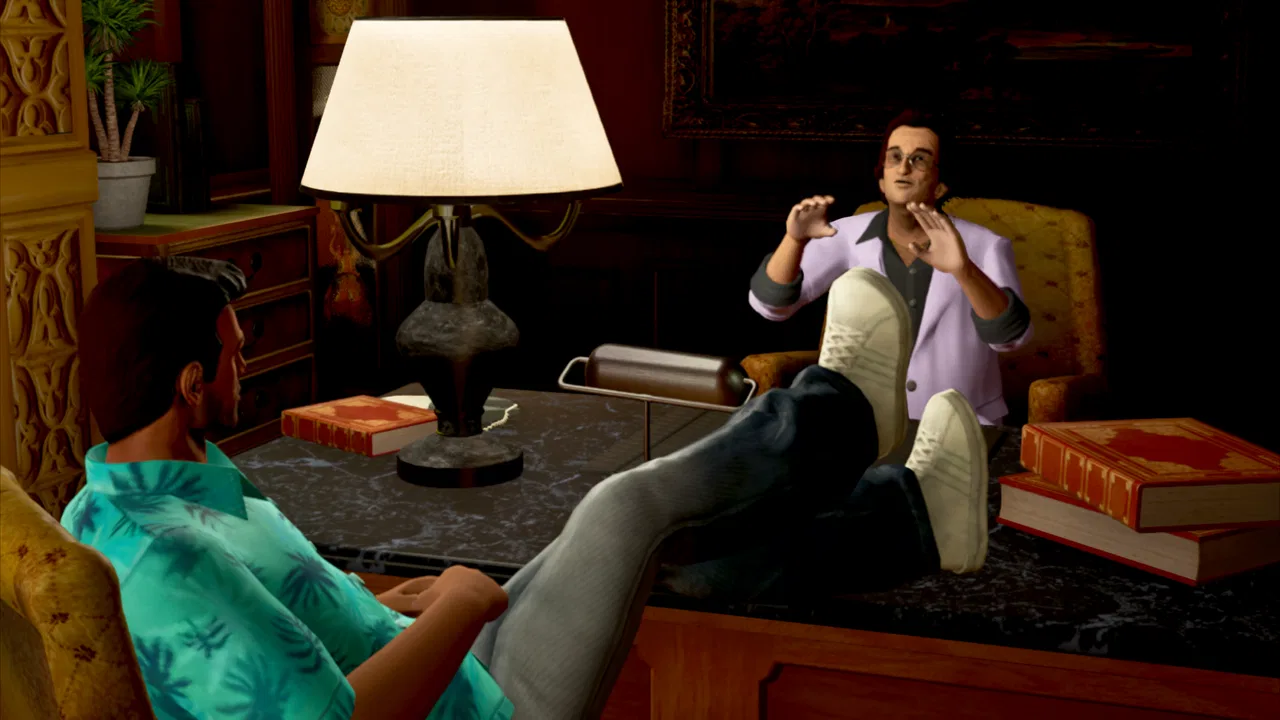
The first impression comes from color. Pink skies, turquoise water, neon signs, palm-lined roads, bright sports cars, and sharply dressed characters make the city feel deliberately artificial in the best way. The design does not aim for a neutral simulation of a real place. Instead, it turns the 1980s into a playable fantasy where every district supports the same exaggerated identity.
You May Also Like

 Google Keep - Notes and lists
Google Keep’s Quiet Growth Shows the Appeal of Simpler Notes
As mobile work gets busier, Google Keep keeps winning a simple contest: capture a thought quickly, find it later, and get on with the day.

 Blood Strike: 2.5 Anniversary
Blood Strike’s Loadouts Turn Every Drop Into a Tactical Gamble
A close look at Blood Strike’s custom loadouts: how fast access to signature weapons reshapes its battle royale rhythm, rewards preparation, and narrows the gap between fights.

 Pandora - Music & Podcasts
Pandora’s Music Is Easy to Start, but Harder to Recover
Pandora’s strength is its low-effort path from a seed to a station. Its weak spot is how much confidence it asks you to place in connection, setup, and quiet recovery.

 8 Ball Pool
 Is Built on Rivalries, Rematches, and Routine
A close look at the rivalries, rematches, shared routines, and unanswered safety questions that turn a quick pool match into a persistent mobile community.

 Samsung Music
’s Quiet Strength Is Playing What You Already Own
Its reach comes less from spectacle than from dependable access to a personal library. That simplicity is both the app’s strongest retention engine and its ceiling.

 AccuWeather: Weather Radar
AccuWeather Review: A Quick, Clear Forecast for Everyday Decisions
For everyday plans, the best forecast is the one you can understand quickly. AccuWeather makes rain timing, radar, and local conditions easy to act on, with a few trade-offs.
More From Our News Desk



That consistency matters because the missions can vary wildly. One moment I was moving through a tense confrontation, and the next I was crossing the city in a flashy car with the radio filling the background. The game can be violent and ridiculous within minutes, yet those shifts rarely feel random. The art direction keeps pulling everything back toward the same colorful crime-film atmosphere.
The city is also easy to read while moving through it. Beaches, hotels, industrial areas, residential streets, and commercial districts have distinct visual personalities. I could often tell where I was without checking the map, simply by recognizing the architecture and lighting. That is an important strength on a phone, where small-screen navigation can otherwise become tiring.
What I especially like is how the setting changes the emotional meaning of ordinary movement. Driving beside the water feels relaxed until a police chase interrupts it. A quiet street can become a dangerous route when a mission sends enemies into the area. The world is not just scenery around the objectives; it gives the objectives their flavor.
A city designed for short sessions and long detours
Vice City is well suited to the way I use mobile games. I can begin with a clear goal, complete a mission, and stop, or I can ignore the main path and spend time driving around, exploring, causing trouble, and looking for a better vehicle. That flexibility makes the game more comfortable for mobile play than an experience that demands a long uninterrupted session.
A realistic everyday scenario would be a commute or a quiet evening at home. I might have enough time for one mission, but not enough patience for a complicated setup. Here, I can load in, follow the next objective, and make progress without needing to remember a dense online system or coordinate with other players. If I have more time, the same session can expand into free roaming.
There is a trade-off, though. The open world can tempt me away from the story so often that the pacing becomes self-directed rather than tightly controlled. That is enjoyable when I want freedom, but less ideal when I prefer a focused campaign with carefully managed momentum. Players who dislike wandering may find the city distracting instead of liberating.
The soundscape gives the driving its personality
Sound is one of the main reasons the game’s setting feels coherent. The radio stations, music, voices, vehicle noise, and bursts of action create a moving soundtrack for the city. I rarely felt that I was simply traveling between mission markers. Even routine driving had a distinct rhythm because the audio made the streets feel inhabited and performative.
The radio is particularly important to the mood. It helps separate Vice City from a generic crime sandbox by making the period feel present in every journey. The songs and broadcasts do more than fill silence; they frame the action with humor, attitude, and a sense of time. When the right track is playing during a fast drive, the game creates a memorable little scene without needing a cutscene.
That audio design also affects pacing. A quiet drive can give me a breather after a difficult encounter, while a sudden chase turns the same road into a source of pressure. The contrast works because the game does not keep every moment at maximum intensity. Its best sequences come from the movement between calm travel, preparation, chaos, and recovery.
Mobile play can make sound more complicated. Playing without headphones means the surrounding environment may compete with dialogue and radio details. I found that the game benefits from a quieter setting, especially during missions where instructions matter. If I only want a quick burst of action with the sound turned down, I still get the basic experience, but some of the atmosphere is lost.
Mechanics that support the mood, with some old-school friction
The core loop is straightforward: travel through the city, take on missions, use vehicles, fight enemies, and gradually become more involved in Vice City’s criminal world. Those mechanics fit the setting because they keep me physically connected to the city. I am not selecting locations from a menu and watching events happen elsewhere; I am usually driving, navigating, and dealing with whatever appears on the route.
Driving is central to the game’s identity. Cars are not just transportation, because choosing a vehicle changes how a journey feels. A fast car makes escape more exciting, while a heavier or less agile vehicle can turn a simple route into a struggle. The city’s roads become part of the challenge, especially when traffic, turns, and pursuit pressure collide.
Combat is functional and familiar rather than deeply tactical. Positioning, movement, weapon choice, and awareness of enemies matter, but the game’s biggest pleasure is usually the situation around the fight. A shootout becomes more memorable when it begins after a reckless drive, spills into a public area, or forces me to improvise an escape.
The most useful habit is to treat each mission as a route-planning problem, not only a combat problem. Before rushing toward an objective, I benefit from noticing nearby roads, open spaces, and possible escape directions. That small adjustment reduces frustration during missions where the real difficulty comes after the target is dealt with.
The mobile controls are the area where personal tolerance matters most. Touchscreen input can make driving and aiming feel less immediate than playing with a traditional controller. I found that careful movement works better than frantic swiping, especially during vehicle escapes. Players who already enjoy console-style games on a phone will probably adapt more quickly, while anyone sensitive to imprecise touch controls may prefer a different platform or setup.
Another practical point is to avoid treating every failed mission as a sign that the game is unfair. Sometimes the better solution is to slow down, approach from another direction, or arrive with a more suitable vehicle. The game rewards a little preparation, but it does not always explain that preparation clearly. That old-school design can be satisfying once understood and irritating before then.
Progress feels personal because the city becomes familiar
One of the game’s quiet strengths is how repeated travel builds a mental map. At first, streets can feel like a maze, particularly when I am trying to escape quickly. After several sessions, landmarks begin to connect. I start remembering which roads lead toward open waterfront areas, which districts feel cramped, and where a wrong turn is likely to create trouble.
That familiarity changes the experience of later missions. I am no longer reacting only to the objective marker; I am making decisions based on knowledge of the city. This is a concrete advantage over many mobile action games that use small, disposable arenas. In Vice City, the route itself can become part of my personal history with the game.
The downside is that the same city can expose the age of the design. Some objectives may require repeated travel, and the freedom to roam does not always come with modern conveniences. I sometimes wanted a faster way to get back into the action after a failed attempt. The slower structure is part of the game’s character, but it will not suit people who expect every minute to be streamlined.
The game’s popularity gives some context to its reach: it has passed five million installs and holds an average rating of 3.7 from around seventeen thousand ratings. Those figures suggest a large audience with mixed reactions rather than universal approval. That matches my own view. The identity and atmosphere are unusually strong, but mobile control comfort and older mission design will determine whether the experience clicks for each player.
Who should play it, and who should choose something else?
I would recommend this game to someone who enjoys open-world crime stories, stylized settings, vehicle-based exploration, and games that allow detours. It is especially appealing if you like the feeling of learning a city over time. The combination of neon visuals, period sound, dark humor, and free roaming gives it more personality than a typical action game built around interchangeable missions.
It is also a good choice for a player who wants a single-player experience that can be approached in short or long sessions. There is no need to wait for a team, match with strangers, or maintain a competitive schedule. I can play at my own pace and decide whether the evening is about story progress or aimless driving.
I would be more cautious about recommending it to someone who wants modern touch controls, realistic physics, or a tightly guided campaign. Players who dislike mature themes should skip it as well, since the violence and criminal subject matter are not occasional decorations. The age rating of 17 and over is an important part of the game’s identity, not a minor store detail.
It may also be the wrong choice for someone seeking a constantly updated online game or a social action experience. This is built around its established city, characters, and campaign structure. A newer action title may offer smoother input, more contemporary mission design, or stronger multiplayer features. Vice City’s advantage is its atmosphere and authored world, not modern competitive depth.
Practical advice before settling into the campaign
I recommend beginning with a short session devoted to learning the movement and camera rather than immediately judging the entire game by the first difficult mission. Touch controls take adjustment, and the city becomes easier once its major areas start to feel familiar. If driving feels awkward, practicing turns and braking away from mission pressure is more useful than simply repeating a failed escape.
It is also worth protecting the game’s slower moments. I get more from the experience when I let a drive play out instead of treating every trip as wasted time. The radio, scenery, and changing traffic are part of the game’s pacing. At the same time, I would not force myself to explore when I am in a hurry; the freedom works best when I choose it rather than feel obligated to see everything.
Another useful approach is to separate experimentation from progress. Free roaming is the right place to test vehicles, explore unfamiliar streets, and enjoy the city’s visual design. Missions are easier when I arrive with a clear plan and resist unnecessary distractions. That distinction makes the game feel less chaotic without removing its unpredictability.
The free price makes it easy to try, but the optional purchase cost means I would still consider whether the full experience suits my habits before spending money. Someone who only wants a few minutes of casual action may not get enough value from the longer campaign structure. A player who enjoys returning to a familiar world, however, may find the purchase more worthwhile than repeatedly buying shorter, less distinctive mobile games.
My final view of the atmosphere
After playing it, I see GTA: Vice City - Definitive as an action game carried by the unity of its art direction, sound, setting, and pacing. The mechanics are important, but they are at their best when they serve the city’s mood. Driving becomes a way to absorb the world, combat becomes a consequence of the criminal fantasy, and the radio turns movement into part of the story’s rhythm.
It is not frictionless. Touch controls can be demanding, some missions feel dated, and the open structure may test the patience of players who want constant forward motion. Those weaknesses are real, especially on a mobile device. Still, they do not erase the game’s strongest quality: Vice City feels like a place with its own visual and musical vocabulary.
For me, the deciding question is simple: do you want a polished modern mobile action loop, or do you want to spend time inside a distinctive 1980s crime world? If the first option matters more, another game may be a better fit. If the second sounds appealing, this is a rare mobile experience where the atmosphere is not decoration; it is the reason the mechanics remain memorable.
Rockstar Games has created a version of Vice City that still works because its mood is so carefully connected to play. I would recommend trying it to anyone comfortable with mature themes and willing to adapt to its older design habits. The best sessions are not always the most efficient ones. They are the moments when the right car, the right stretch of road, and the right piece of music make the city feel briefly alive.
FAQs for GTA: Vice City - Definitive
01What is GTA: Vice City – Definitive Edition?
GTA: Vice City – Definitive Edition is a remastered version of Rockstar’s classic open-world action game, set in a stylized 1980s Miami-inspired city. You play as Tommy Vercetti, building a criminal empire through missions, shootouts, driving, property management, and exploration. The Definitive Edition includes upgraded visuals, improved controls, enhanced lighting, and other presentation changes compared with the original release.
02Can I play GTA: Vice City – Definitive Edition offline?
Yes, the game is designed primarily as a single-player experience and most of the story can be played offline after the required installation and initial setup are completed. An internet connection may still be necessary for downloading the game, verifying access, installing updates, or restoring purchases. Availability of offline play and account requirements can vary depending on the platform and version.
03What devices are compatible with GTA: Vice City – Definitive Edition?
Compatibility depends on the specific Android or iOS device, operating-system version, available storage, and the version distributed through the official app store. Because this is a visually enhanced open-world game, older phones and tablets may not be supported or may provide weaker performance. Before downloading, check the current store listing for supported devices and make sure you have enough free space for the complete installation.
04Does the game include the complete Vice City story and original missions?
The Definitive Edition includes the main Vice City campaign, featuring Tommy Vercetti’s rise through the criminal underworld, along with its missions, characters, vehicles, weapons, radio stations, and open-world activities. It is not a new sequel or a completely different game. The remaster updates the presentation and controls, but the core story, setting, and gameplay structure remain based on the original Vice City experience.
05Is GTA: Vice City – Definitive Edition suitable for children?
No. GTA: Vice City – Definitive Edition is intended for mature audiences because it contains frequent violence, criminal themes, strong language, drug references, sexual content, and other adult situations. Parents should review the age rating shown in their region and consider using device-level purchase and parental controls. The game also includes open-world activities that may not be appropriate for younger players, even when they are not required for story progress.
Pros
- Faithful recreation of Vice City’s iconic 1980s atmosphere
- Large open world with plenty of optional activities
- Memorable radio stations and licensed music enhance exploration
- Improved aiming and weapon controls feel better on mobile
- Supports cloud saves for easier progress across compatible devices
Cons
- Requires substantial storage space for installation and updates
- Some visual glitches and bugs may still appear during gameplay
- Touch controls can feel awkward during driving and combat
- Licensed music may be removed or changed in future updates
- Older devices may experience performance drops or compatibility limits

GTA: Vice City - Definitive
Gallery